Monday, October 22, 2018

Do Games Count?


As a class we have looked at a variety of different electronic works, including self-generating texts, e-literature, and e-poetry in our digital humanities course with Dr. Justus.  In this part of the course, we've started to learn about different types of interactive games. This has led us to question, do games count as scholarly works that can be researched/created by DHers?
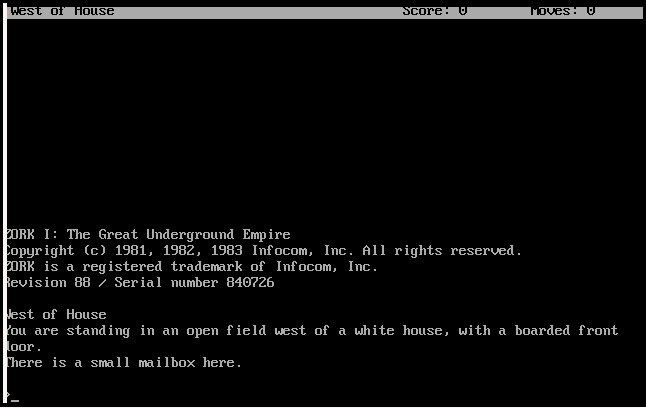
Image result for zork
When you think of games, you think of exciting plot lines, getting to make your own decisions, and just fun in general. This describes the interactive computer game “Zork” to a T. Basically, Zork is an interactive story, plot line, game where you are guided by instructions and key words but you have full control of your fate in the game. For example, in the game the main goal is to get inside the white house so you can continue the story. Right when you walk inside the house the room is described to you and there are things you are able to pick up and keep for future use. Well, you get in the house through the window into the kitchen and there are various items you are able to take, food being one of them. Here is where a very important aspect of the game is. If you blow past the food and try to continue on with the game, later on in the game you will not have enough energy to complete a task, resulting in losing the game. Where as, if you take the time to eat the food then you will have enough energy throughout the story. Zork is a fun game for anyone to play and figure out. It does not have any hidden meanings and is not about a heavy subject like other works, however, it is just as respectable as any other piece of e-literature because of the intricate plot line and interactiveness for the player.

Games usually stem along the line of wanting to provide players with a specific kind of experience. These experiences are usually based upon the nature of the game, and the genre it uses to label itself as. I like to look at games differently, instead of looking at them as their labels (the genres) I tend to look for two aspects. Entertainment and Education. This characterization obviously relies on a spectrum between these two statements. However, I’ve found that these two labels really help to establish how much a person is going to get out of the game. For example, Maybe Make Some Change was a game designed with an unquestionable amount of education involved in the production, with entertainment being put on the back-end of its completed design. This “game” I’d even stretch to call it, was devised in order to retell the events of past in order to educate the player on a real-life event they’d probably never heard of before. It’s usually in a games best interest to captivate its player-base in one way or another, and majority of the time it involves plenty of topics, from: graphics, replayability, narrative, gameplay, control schemes, soundtracks, leading up to the game, and sometimes even the designers of the game. However, as stated previously, majority of the enjoyment from a player-base is how honestly a game expresses its intentions, entertainment or education.
This is where the discussion of the game should take place. On the topic of how honestly the creators of the game decided to express that within this more arguably education game than an entertaining one. The genius behind its creation is not in the narrative however. The genius stems from how they produce the replayability within the game. Usually, a producer aims to make a game more replayable in the interest of the business for the game, and to lure players into investing more time to be spent within the game. Maybe Make Some Change somehow seems to do the opposite. Its replayability is tedious and exhausting and from what I’ve observed, leaves players from wanting to even finish the game in the first place. This allows for two things to happen for players to experience the greatest part of the game early on, and to create discussion revolving the game itself. For a game revolving around education, this combination is perfect, because it allows players to experience the best part of the game early on, without having to spend extra time into the game, while also providing easy discussion once having finished spending time on the game. However, there is one more thing to add to the equation, and that would be the reward for those who are dedicated to replaying something deemed replayable. Those who wish to invest more time into the game begin to reveal the puzzles and secrets about the game that would otherwise be unobtainable to those without the effort to attempt this feat. As an educational game, MMSC does a great job of providing short-term enjoyability from those not willing to put a lot of effort into a game, but also does a great job at rewarding those who are willing to invest into it. This provides for an emotional, rewarding, and controversial narrative, ultimately a great experience when it comes to games. The player is taken on a journey that confuses them, but rewards the confusion with slight moments of achievement with the intention of driving further investment into the game with more words being accessible to the player.
This ultimately provides the timeline of confusing the player → rewarding the player → confusing the player some more → rewarding some more → testing their problem solving skills → resulting in either failure to continue playing or more investment into the game → for the latter, the player continues to play, ultimately getting frustrated and angry with continued failure, but a sense of perseverance and an unwillingness to give up in order to achieve total completion. → This is then rewarded by further insight to the narrative, and then the final reward being the full story leading to the creation of the game itself. The producer allowing insight to their game, can arguably be one of the greatest achievement because it allows the player to feel connected to the creation of the game. It allows the player to feel responsible for the creation of the game in the first place. Regardless of the game, it delves into the notion that the producer created the game personally for the person who was willing to complete the game. This, in-turn, is the success behind why an educational, and narrative driven game like MMSC, into being a genius creation.

After looking at these different pieces of electronic works, you can see that we came to the conclusion that games do count as scholarly works that can be researched / created by DHers. These games all include their own plot line, users get to make their own decision, they’re interactive, and more qualities that basic, real games include.  

Thursday, September 27, 2018

Bots


Are Bots an Ethical or Unethical Technology?

When I first heard that we were going to be talking about bots in class my mind immediately went to the 2005 children's film "Robots". Then as class went on and I began to understand the true power that digital intelligence has. to say the least it scared me! All I could think of was the Orwellian society in the book 1984, how members of society were watched by their government through their television screens. Call me paranoid but you always hear about how people believe the government used "Alexa" to listen to our conversations listening for "trigger words". Despite all my theories, digital intelligence is the future of society, it will create so many opportunities for people that they didn't even know was possible. In fact digital intelligence has already been helping our troops. A military device was developed called the "Robo Dog", this "dog" is suppose to carry our troops supplies and enter zones that are unsafe for our troops and it is able to withstand any terrain and is incapable of being knocked over. This is a form of digital intelligence because it is obviously not a real dog, it is a computer that is carrying the supplies for our troops. Click on the link under the "Robo Dog" to watch a video. Digital intelligence is the future and is extremely interesting and helpful but it needs to be used wisely. In class we saw examples of various "simple" twitter bots. Even just being used on a social media platform they can have an impact.
https://youtu.be/EstNBGu3_Co

Is the future of Humans really Human?


If you haven't heard of either of these two gentlemen above, I strongly urge you as a reader to check out the conversation they have about AI. Not only are my feelings about AI positive, but I truly believe that there is a positive future ahead when Humans and AI can work together symbiotically.

Image result for cyborg

Recently, in class, we've been discussing the potential that AI has, and how it has already been implemented in society. While in class, we went over some simple bots that would take information from users (the  info was based on the bot's algorithms) and produce outputted material.

Although rudimentary in regards to the true capabilities of an AI, people can begin to see the simple things that an AI can be programmed to do. After going over the material we have in class, it's become evident that a discussion about AI is one that I'm quite passionate about, and I look forward to continued discussions about such topics!

Bots are a very interesting tool used by many people today and can be very useful at times. They aren't just a program in a computer that automatically does certain things. They can be found anywhere from Siri on your iPhone to a real life transformer. Google homes or "Alexas" are also a very new form of artificial intelligence that many people I know have.  In general, bots are automated programs that run on the internet and can make or program things randomly or on command from a computer bot user. For example, they have been used on Twitter to make rhyming poems from retweeting tweets from random people and put them together so that the last word on each pair of tweets rhyme. When bots make these kind of posts they are referred to as self-generating texts. In addition to this, bots can be used to create political statements.  For example, the bot NRA Tally, on twitter, tweets out the statistics of mass gun violence anytime it is committed in America. So, this technology can be constructive when used in positive ways.
Bots and Self Generating Text

The application of a bot can also be used in negative ways.  Though the aforementioned Twitter and self-generating text bots me seem harmless, both can be used in ethically questionable ways.  An example of an ethically questionable Twitter bot would be a bot network that produces fake followers.  These sorts of bots capitalize on Twitter's follow recommendation algorithms by providing a false sense of legitimacy to a particular profile.  This means that in addition to the fake followers that can retweet any tweets, there are real people that follow the profile and are influenced by what is tweeted out.  The Twitter profile now has the power to influence public opinion when these bots are used on a large scale.  Authoritarian regimes have also been known to use these social media bots in order to suppress public opinion.  The bots networks that these governments use are designed to send out so many tweets/statuses that it pushes messages sent out by opposition activists down in the media feed, decreasing the amount of users who view it.  

The question, "Are bots bad or unethical technology?", is actually a lot more complicated than it may seem. Taking a different perspective may shed light on the answer.  If you view a bot as a tool, and neither an ethical or unethical device, the question becomes more clear.  The question of ethics does not apply to the tool, it applies to the person using it.  

Tuesday, September 18, 2018

Electronic Literature


Ludwig Wittgenstein
Electronic literature is literature that was created exclusively for or on digital devices. I think that this is amazing because it can bring to life many poems, short stories, and historical events. Before this class I just thought that E- literature was online ebooks, or articles. After being in Digital Humanities for only a week, I have learned that that’s not the case at all after being exposed to works such as “Mr. Pimpton’s Revenge”, and “88 Constellations”. I think that “Mr. Pimpton’s Revenge” was one of the coolest pieces of E-lit that I have seen because as the story was being told, you were being taken on a trip with the story! The Author utilized google maps and connected a specific destination with each place in the story, everytime you clicked on a destination a snippet of the story was uncovered. E- Literature lets the reader interact with the piece, it cannot be printed out like a book because it will lose its razzle-dazzle effect to grab the viewer's attention. “88 Constellations,” is also a very interesting piece of e-literature especially if you like astronomy, astrological signs, and Ludwig Wittgenstein. “88 Constellations” is a piece that presents itself as the night sky full of stars. However, when you run your cursor over the stars, patterns of constellations reveal themselves. The shape of the constellation is shown as well as the name. When you click on one, there is a informational video connected with each one educating you the Philosopher, Ludwig Wittgenstein. It is a very informative piece that I found extremely interesting. Electronic Literature is such an amazing use of technology but people often do not know what it actually is. Hopefully, in the near future people will understand the true definition of Electronic Literature.

- Libby Korber


Erik Bengtson E-Literature


What is E-Literature?
Image result for e-literature
E-Literature is a form of literature that is specifically designed to be viewed/interacted with on an electronic media device such as a tablet, smartphone, or computer.  These works are not to be confused with E-books, being that e-books are not specifically made with the intent of being electronic media.  E-books are digitized versions of print, and E-literature is "born digital".  E-literature can only exist in the particular media for which it was developed.

When I was going through the different varieties of e-literature I came across a work by Maria Mencia called Birds Singing Other Birds Songs.  The reason why I chose this particular piece was because I wanted to illustrate just how broad the concept of e-literature can truly be.  The author of this piece of literature wanted to explore the idea of kinetic typography, or the animation of images and sound.  The piece has 12 different animations that you can play simultaneously, or change at will.  Each animation is a bird song, and as it sounds a written transcription of the song is shown in the shape of the bird. 
Birds Singing Other Birds' Songs
This just shows the wide variety of what can be considered E-literature, and is a perfect example of something that could not exist had it existed in traditional analog print media.

Monday, September 17, 2018

E-Literature

E-Literature

E- Literature, or electronic literature, is a type of literature that shows work strictly on digital devices such as phones, computers, etc. More specifically, electronic poetry is a type of e-literature that I find very interesting. Essentially, electronic poetry is just poetry that is made and used to view on digital devices as well. One specific piece of electronic literature that I find interesting is "88 Constellations" by David Clark. This piece of interests me because it gives you a visual representation of some of the different constellations found in the stars and gives a brief explanation of how those shapes came to be known from people today. I have always been sort of interested in space and the stars, so this piece was definitely one that fit me and was interesting to listen to.

88 Constellations


Monday, September 3, 2018

Image result for Libby KorberHello! My name is Libby Korber, I am currently a sophomore at UPJ majoring in Early Childhood Education and Special Education with a minor in Psychology. I am from a very small town in Central PA called Millerstown, it is a town where if you blink you will miss the entire town. I have shown people my hometown before and they have said that it is not a town but an intersection. The county where I live has 1 stoplight that was put in about two years ago. I graduated with a class of 58 people and that's why I chose UPJ, because I wanted a small school. I use to play soccer here at UPJ (seen in picture to the right) but I decided to take this year off to focus on the 18 credits I am taking. I love being active, playing sports or hiking or biking. I am excited for this class this semester and I hope this post lets you all know a little more about me.

Thank you,

Libby Korber

Friday, August 31, 2018

Darren Brautigam Introduction

Hello!

My name is Darren Brautigam. I am a freshman at UPJ and majoring in Multimedia and Digital Culture. I am currently in a class called "Digital Humanities." This class is mainly about the mix of digital technology and human interaction. I am a big hockey fan and played it throughout my elementary, middle, and high school career. Next, I am the youngest out of my two other siblings. I have an older sister that is 22 years old, and an older brother who is 21 years old. There are a total of three pets in my house back in Pittsburgh including two small dogs named Sophie and Stella, and a cat names Leo. Lastly, I graduated from Hampton High School about thirty minutes north of the city of Pittsburgh.

                                                                              Thanks,
                                                                                          Darren☺